Texts From Your Club's Own Name — Plus One-Member Messages and a Searchable Archive
3 July 2026
A season-long plan for club messages: what to send each month, what only when it happens, which channel each deserves, and how to keep a record of every send.
Every club has a member who reads nothing. The renewal reminder, the lift-out date, the note about pontoon repairs: all of it lands in a folder, or the bin, unopened. It is tempting to blame the member. But most of them were trained into it, one unnecessary email at a time, by the club itself.
Members' attention is a budget, and every message spends some of it. Send a cheery nothing-in-particular email in June and you have taxed the message that actually matters in July. A communications calendar is not about sending more. It is about deciding in advance what deserves to be sent at all, and protecting the budget for it.
The bones of the plan write themselves, because a British sailing season has fixed points. A March relaunch note: the fleet is back in the water, here is what changed over winter, booking is open. A short email each month through the summer carrying anything genuinely new — a boat added, a rule adjusted, an evening event. A September wind-down with lift-out dates and last sails. A January renewal message setting out fees and what membership buys, sent early enough that nobody needs chasing in February.
That is roughly ten planned messages a year. Write the skeleton on one page and give each entry a rough send date. Then apply the only rule that matters: if a monthly note has nothing in it, skip it. An empty month is fine. A padded email is not.
Two kinds of message cannot be scheduled: weather and maintenance. A gale arrives when it arrives. An engine fails on a Friday evening with a full weekend of bookings behind it. These are exactly the messages that get written badly, because they get written in a hurry.
So draft them in advance. A weather template needs four things: what is forecast, which sessions are affected, what members should do, and when you will next update them. A maintenance template needs the boat, the fault, a realistic timescale, and what happens to existing bookings. On the day you fill in the specifics and send within minutes, and the message reads like it was written by someone calm — because it was, three months earlier.
The two channels do different jobs. Email carries detail: dates, prices, instructions, the three paragraphs of context behind a rule change. A text carries urgency and nothing else. It interrupts whatever the member is doing, which is precisely why it works and precisely why it must stay rare.
A workable test: if the message can wait until this evening, it is an email. Boat withdrawn an hour before a booking? Text. Pontoon closed from tomorrow morning? Text. New fuel billing arrangement starting next month? Email, every time. Clubs that text weekly find their texts being read like emails within a season, which is to say glanced at and forgotten. Clubs that text four times a year find every one of them lands.
A surprising amount of club traffic is one person's business announced to everyone. The member who keeps overrunning the morning slot. The lapsed subscription. The fenders left on the pontoon since Tuesday. Broadcasting these spends forty people's attention on a matter for one — and the person it concerns often fails to recognise themselves anyway.
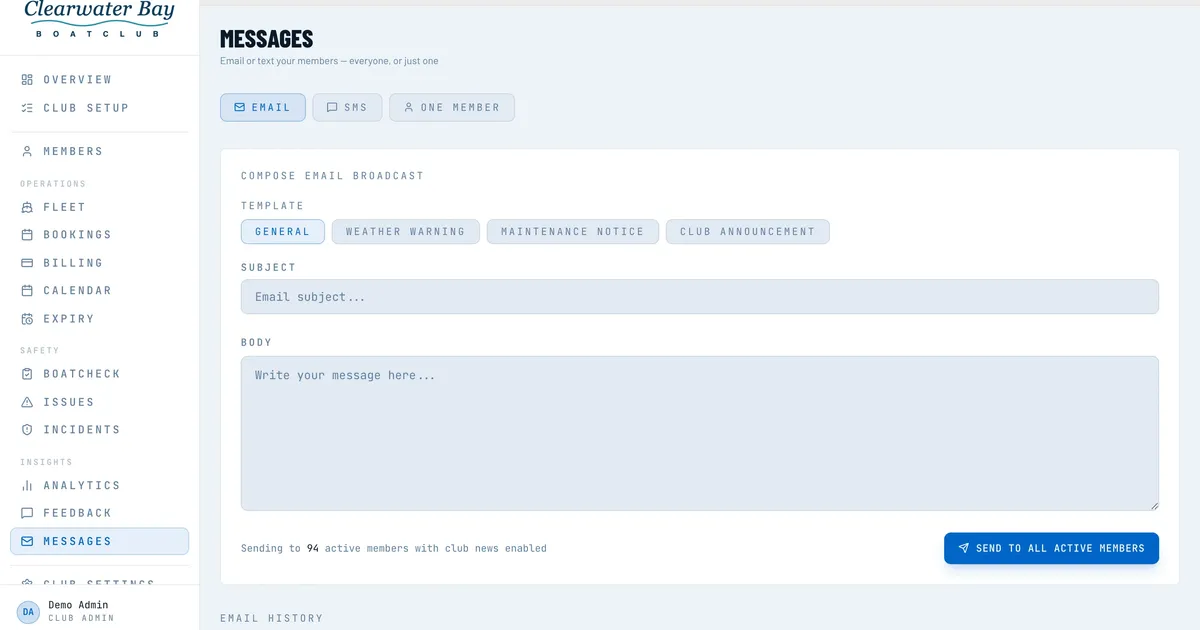
Before any send, ask who actually needs it. If the answer is a name rather than the membership, send it to that name. It is kinder, it works better, and it keeps the broadcast channel meaning something. Nauticore draws the line explicitly: a broadcast goes to the whole club, while a separate One Member tab texts a single person. But the principle holds whatever tool you use.
At some point in the autumn, someone at a committee meeting will ask whether members were told about the cancellation-policy change, and when. If the answer lives in one volunteer's personal Sent folder, the club does not really know. If that volunteer has stepped down, it never will.
Keep a log of every club send: what went out, on which channel, on what date, to how many people. It settles disputes — the change was emailed to all forty-two members on 14 March, here it is. It shows the incoming secretary what a normal year looks like. And it exposes your own habits: the month you sent five messages, the two months you sent none. Nauticore keeps a searchable history of every email and text automatically, but a shared spreadsheet does the job too. The point is that the record exists somewhere other than someone's memory.
A communications calendar sounds like bureaucracy for a club that just wants to sail. It is the opposite: fewer messages, sent at the right moments, on the right channel, each one opened because the ones before it were worth opening. The whole plan fits on a page. Write it in the winter, and the season runs quieter for everyone.
See it in action
All Nauticore features are live in the interactive demo — no signup required.