Texts From Your Club's Own Name — Plus One-Member Messages and a Searchable Archive
3 July 2026
A three-tier triage discipline for boat clubs: what counts as minor, medium and urgent, who hears about each and how fast — so faults stop dying in the group chat.
Every club has had one. A boat that has been "a bit down on power" since Easter, mentioned once in the WhatsApp group between a photo of someone's lunch and a question about the car park gate code. Three people saw the message. Nobody wrote it down. Six weeks later the engine dies a mile from the moorings, and the engineer who opens it up asks the obvious question: how long has it been doing this?
The failure here isn't the fault. Faults are normal; shared boats work hard. The failure is that nobody had to decide what the report meant. A working triage system asks the reporter one question, how bad is it, and routes everything else from there. Three severities are enough. What matters is that each one carries a different promise about who hears, and how fast.
The instinct is to ask for a thorough description: what happened, at what revs, in what sea state. Resist it. The member reporting the problem is usually standing on a pontoon with wet hands and a crew waiting, and every extra field you demand raises the odds they report nothing at all. A vague report that gets filed is worth ten detailed reports that never got written.
So ask for two things: a category (engine, controls, radio, seating, whatever fits your fleet) and a severity. Category tells the right person to look; severity tells them when. Detail can follow once someone rings the reporter back. Severity is the one judgement a member can make in five seconds: can the boat still go out, should it go out, or must it not?
A sticking throttle detent. A torn corner on the helm seat. A speaker that crackles above half volume. None of it stops the boat working, and none of it justifies a special trip. The discipline with minors is to log them and deliberately not act — then sweep the whole list for each boat in one visit at the next maintenance window. One trip, one parts order, four small jobs done.
The trap is letting "minor" slide into "ignorable". An unlogged minor becomes club folklore: oh, that seat's always been like that. So review the minor list monthly, per boat. Three small complaints about the same system are not three minors; they are one medium wearing a disguise.
A medium is anything a member would want to know about before booking, and someone should fix within days. An engine that starts on the third attempt. A depth sounder showing blank. Steering noticeably heavier to one side. The boat can still be used, but the clock is running.
Two rules make mediums work. First, every medium gets an owner by name — not "the committee", not "maintenance", a person. Second, that person hears about it by text, within minutes of the report, not whenever they next scroll the group chat. A message seen by twelve people is owned by none of them; a text that lands in the engineer's pocket while the reporter is still walking up the pontoon gets acted on. This one change, more than any other, separates clubs where things get fixed from clubs where things get discussed.
Urgent means the boat must not go out: fuel smell in the bilge, play in the steering, an engine that cut out under way. Three things need to happen fast, and in this order. Take the boat out of service so nobody else can book it. Alert the manager directly, not via a thread. Then tell every member with an upcoming booking before they load the car.
That last one is the difference between a club that looks organised and one that doesn't. The worst version of urgent is a family arriving on Saturday morning to find a handwritten note taped to the console. Cancelling their booking on Thursday evening with an apology and a rebooking offer costs you five minutes. The note on the console costs you goodwill you will not quickly earn back.
A member who reports a fault and hears nothing will report one fewer fault next time, and eventually none. The fix is cheap: when an issue is resolved, tell the person who raised it. One line will do — fixed on Tuesday, corroded connector, thanks for flagging it. You are not just being polite; you are maintaining the pipeline that keeps faults visible.
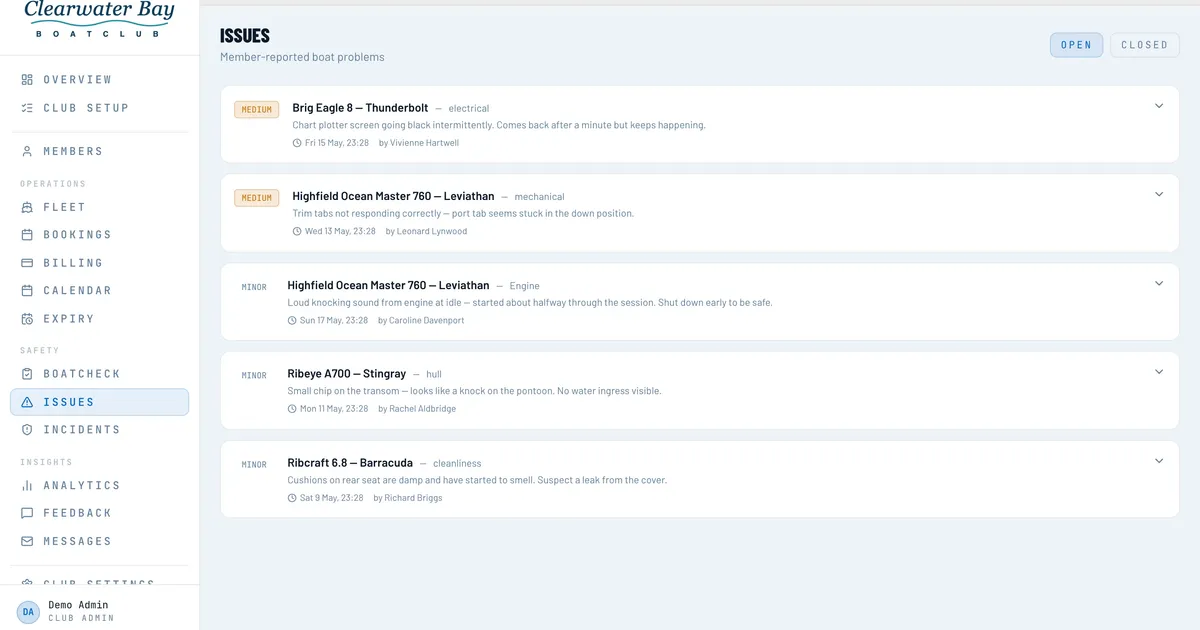
Then, at season end, read what the log tells you. Issue counts per boat show which hull is quietly costing more than its sisters — useful evidence when the committee debates replacing her. Counts per category show patterns: if seating complaints cluster on the training boat, that is a purchasing decision, not a coincidence. This is where software earns its keep. Nauticore, for one, has members file issues by category and severity in a couple of taps; medium and urgent reports go straight to admins and maintenance contacts by text, urgent ones reach the managers too, and the season's history rolls up into per-boat severity charts and a category breakdown you can act on.
None of this needs a big fleet or a paid role to run it. It needs three severities, three promises, and the small discipline of never letting a fault live only in the chat.
See it in action
All Nauticore features are live in the interactive demo — no signup required.