Texts From Your Club's Own Name — Plus One-Member Messages and a Searchable Archive
3 July 2026
Blocking a boat out for liftout is easy. Doing it when members already hold bookings is where clubs slip. How conflict-aware blocking, prompt notice and a little goodwill keep the peace.
A member books the club RIB for Saturday morning, watches the forecast all week, then drives forty minutes to the pontoon to find the boat on the hard with a pressure washer going over her bottom. The liftout was arranged a fortnight ago. The yard knew. The committee knew. The only person who did not know is the one standing in the boat park holding a dry bag.
Most shared-fleet clubs have a version of this story, and it is rarely anyone's fault in particular. The maintenance plan lives in an email thread, the bookings live somewhere else, and nobody thinks to check one against the other. Blocking a date for a regatta or a liftout is the easy part. Blocking a date when three members already hold bookings on it is where clubs fumble.
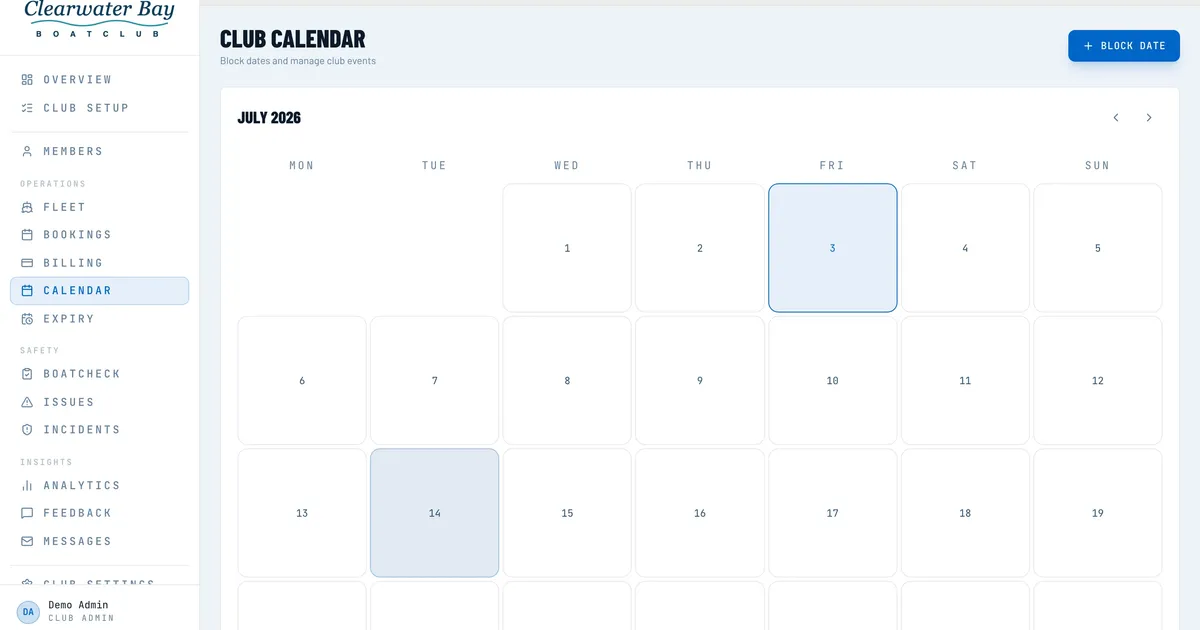
The fix starts with a blunt rule: the calendar should not let you block dates blind. When an admin blocks out a boat in Nauticore, the system checks the range against existing bookings first. If members already hold slots on those days, it lists them before anything is committed: who, which date, which slot. The block does not land until you have seen exactly whose plans it breaks.
That one screen moves the discovery from the pontoon, three weeks later, to the moment of decision — when there is still time to handle it well.
Once the clash is in front of you, there is a genuine choice to make, and the two options suit different situations.
The wrong move is the third option many clubs take by default: block the dates, say nothing, and let members find out when their booking quietly vanishes.
Members are remarkably tolerant of maintenance. Boats need antifoul; everyone knows it. What they do not tolerate is silence. A cancellation that arrives the moment the liftout is booked, with the reason spelled out, reads as a well-run club. The same cancellation discovered by accident a week later reads as contempt.
The standard worth holding is simple: email and text message, sent when the decision is made, with the reason in the body. Not your booking has been cancelled but your booking has been cancelled because Kingfisher comes out of the water for antifoul on the 14th. The second version costs one sentence and saves one resignation letter.
Nothing obliges a club to compensate a member whose Saturday was cancelled. It is still a cheap thing to do. That member planned a day on the water and lost it through no fault of their own, and a small gesture turns a grievance into a story about how well the club behaved.
Two gestures work. The first is an extra booking on top of the member's normal quota, so the lost day does not eat into their allowance; Nauticore calls these golden tickets, and a bumped Saturday is exactly what they are for. The second is softer: a short personal note from whoever made the call. Thirty seconds of typing, and the member tells the story of the club that handled it well rather than the story of the pressure washer.
And if every other boat is taken that weekend, the waitlist earns its keep. The member joins in one tap and gets the automatic offer the moment a slot frees up.
The best conflict handling is the kind you never trigger. Liftout, antifoul, the insurance survey, the regatta the club hosts every July: most blocks are known months ahead. Put them on the calendar in the depths of winter, when nobody has booked anything, and there is no conflict to manage at all. Members see the blocked dates from the day they plan their season and book around them without a second thought.
Do that, and the conflict tooling is reserved for what it is really for: the genuine surprises. A cracked gearbox does not consult the calendar. When it happens, you want software that shows you who is affected, tells them straight away with the reason, and leaves the club looking organised rather than evasive. The blindside on the pontoon is entirely avoidable. It just has to be designed out.
See it in action
All Nauticore features are live in the interactive demo — no signup required.