Texts From Your Club's Own Name — Plus One-Member Messages and a Searchable Archive
3 July 2026
Safety culture is what members do when nobody's watching. How volunteer boat clubs make good practice the easy option: quick pre-use checks, no-blame fault reporting and visible follow-through.
Walk into most club houses and you will find the folder. Laminated pages by the noticeboard: engine start procedure, kill cord policy, what to do if someone goes in the water. It is usually thorough, occasionally signed off by a committee, and almost never read. That folder passes what you might call the laminate test. It proves the club has written things down.
The pontoon test is different. It asks what a member actually does at half past six on a grey Tuesday morning, alone, keen to get out before the wind builds. Do they clip the kill cord before starting? Do they lift the engine hatch, or decide the last person probably checked? Culture is the sum of those private decisions, and no folder governs them. What governs them is whether the club has made good practice the obvious, easy, normal thing to do.
Volunteer clubs rarely fail on intention; they fail on friction. If the pre-use check lives on a damp clipboard with a missing pen, most members will skip it and feel only mildly guilty. If it runs to forty items, they will skim it. The fix is not more insistence — it is better design.
A good pre-use check takes two minutes and covers the things that actually strand people: fuel, kill cord, bilge, steering, lines, radio. Keep it short enough that doing it feels quicker than deciding not to. Put it where the member already is, which these days means a phone or a tablet by the pontoon gate, so the record makes itself and nobody has to transcribe soggy paper on a Sunday evening.
Every club engineer knows the pattern. A member notices the throttle is stiff, says nothing, and hands the boat back. The next member finds out exactly how stiff halfway across the channel. Ask why the first member kept quiet and the answer is nearly always social: they feared being blamed, billed, or quietly marked down as the person who breaks things.
So the reporting rule has to be explicit and repeated: we would always rather know. A stiff throttle reported on Saturday is a maintenance job; the same fault discovered under way is an incident. Make reporting take a minute, let members pick a category and a severity rather than compose an essay, and thank people by name when they flag something. The member who reports a slipping clutch has done the club a favour, and should hear so.
Nothing kills reporting faster than silence. If a member flags a weak bilge pump and three weeks later the boat is still on the water with no word from anyone, they draw the sensible conclusion: reporting is theatre. They will not bother twice.
Closing the loop matters more than raw speed. Acknowledge the report, say what will happen, and tell people once it is fixed — the step most clubs skip. "Reported Tuesday, repaired Thursday" is the most persuasive safety notice a club can publish, and it is not a poster. It is proof the system is alive.
The annual safety lecture in February is a fixture at many clubs, and it fails for a predictable reason: by August nobody remembers March. Attention is scarce in a volunteer club, so spend it in small, timely amounts.
Five minutes on the pontoon on the first cold weekend, about cold-water shock and the state of the lifejackets, will outlast an hour in the club house in midwinter. A short note when the big spring tides arrive. Two lines after a near miss, anonymised, focused on what to do differently rather than on who did what. Specific beats comprehensive, and recent beats annual.
How do you know whether any of this is working? Not by counting posters. Count the things members actually do. What proportion of outings began with a completed check? How many faults were reported this quarter — and treat a rising number as a likely sign of trust, not of a collapsing fleet. How long, on average, from report to repair?
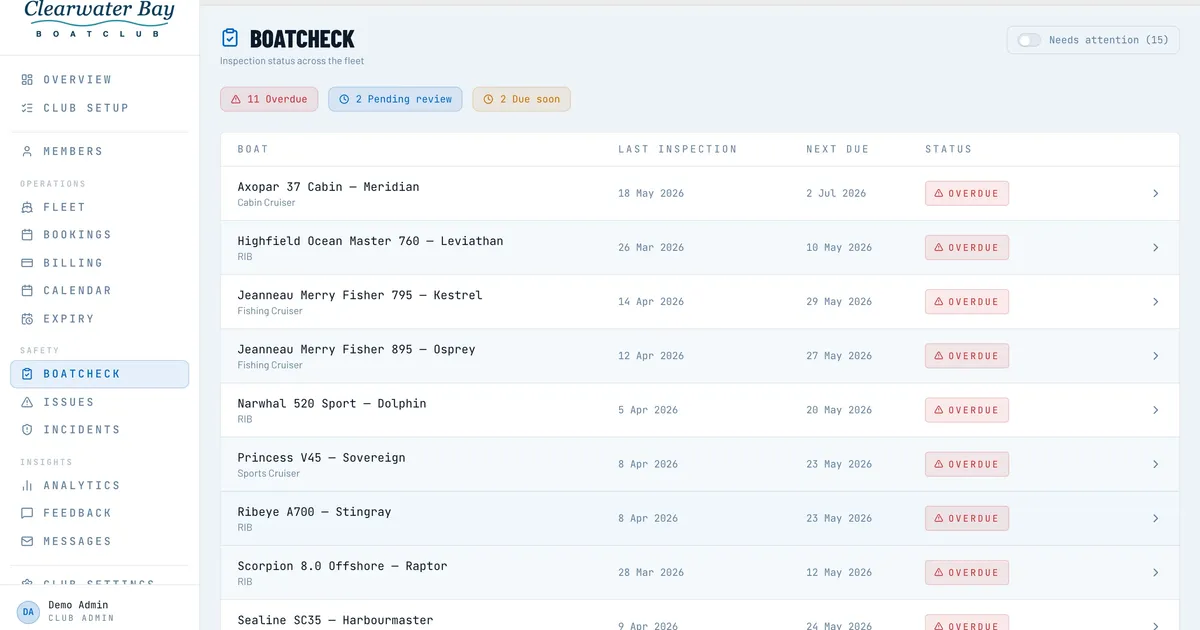
This is where software earns its keep in a volunteer-run club, because nobody has spare evenings to compile those numbers by hand. A system such as Nauticore logs member fault reports with category and severity and charts issue trends across the fleet; its BoatCheck add-on runs pre-use inspections on a tablet and shows at a glance which boats are overdue. The numbers make the culture visible.
But they only make it visible. The culture itself is still built the slow way: a check that takes two minutes, a report that earns thanks rather than blame, and a repair that everyone hears about. Establish those three habits and the folder by the noticeboard can stay laminated, unread, and largely unnecessary.
See it in action
All Nauticore features are live in the interactive demo — no signup required.