Texts From Your Club's Own Name — Plus One-Member Messages and a Searchable Archive
3 July 2026
Maintenance always loses the calendar fight with a sunny Saturday. How to pick quiet windows from booking data, block dates properly and make sure affected members hear first.
Every club has a boat that is overdue its service. Not because anyone forgot: the engine hours are on the whiteboard and the engineer has been emailed twice. But every date anyone proposes turns out to be somebody's booking. The liftout slides from March to April, April to "after the bank holiday", and by June the boat is running on goodwill and an oil filter that should have been changed in the spring.
The problem is structural. A booking has a name attached: a member who wants their Saturday morning and will say so if it vanishes. Maintenance has nobody. It waits on a list, patient and silent, until it stops being patient and becomes a breakdown, usually on the sunniest weekend of the year, which is also the weekend with the fullest calendar.
You do not need to guess when to schedule work. Twelve months of bookings will tell you, quite precisely, when the fleet sits idle. Most clubs show the same shape: weekends heavy, Friday afternoons busier than anyone expects, and a trough somewhere mid-week, often Tuesday or Wednesday, when half the boats never leave the pontoon.
Look at utilisation by day of week, and at the morning and afternoon split, before you ring the engineer. If Tuesday mornings run at a fifth of what Saturday mornings do, choosing the window stops being a judgement call. A two-day job starting on a Tuesday in early March might displace one booking. The same job on the first warm weekend in May could displace eight — and you will hear about every one of them.
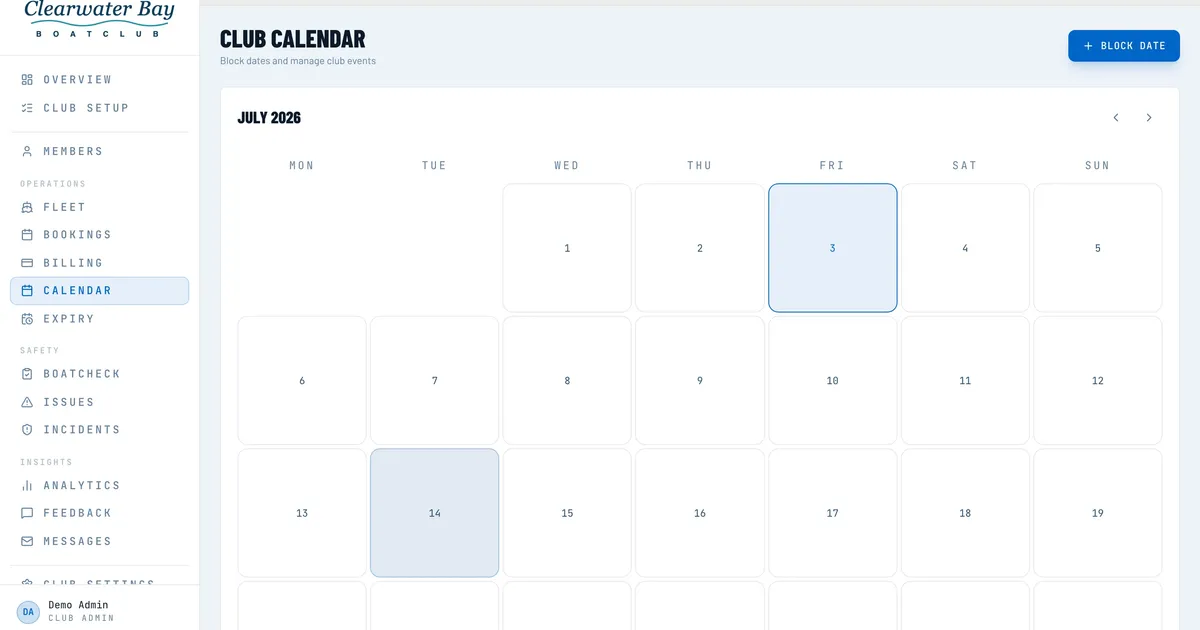
Once you have a window, block it in the booking system properly. Not a note in the WhatsApp group, not a word with the bosun at the bar: an actual block, so nobody can reserve the boat while she is in slings.
The step clubs skip is checking what is already on the calendar. If members can book two weeks ahead, some will have slots inside your maintenance dates before you chose them. Block the dates without dealing with those bookings and you have manufactured the exact scene you were trying to avoid: a member arriving with a cool box and two guests to find the boat gone.
Better booking systems detect the clash for you when you block the dates, and walk you through cancelling and notifying in one pass. If yours does not, the sequence is still the same — find the clashes first, cancel them deliberately, and only then treat the dates as blocked.
Set one standard and keep it: a member whose booking is cancelled for maintenance hears about it before anyone else does, and hears why. Nothing corrodes goodwill faster than finding out at the pontoon, or worse, from another member who knew.
The reason does more work than clubs expect. "Your booking on the 14th has been cancelled" reads as carelessness. "We are lifting her on the 14th for the annual engine service; she will be back in the water by the 18th" reads as a club that looks after its boats. Same cancellation, entirely different message. Add a route back where you can: another boat that day, or first pick of slots when she returns. Most members will take a planned service on the chin.
The app and the boatyard need to agree. If a boat is out of the water, she should be visibly out of service in the booking calendar: marked, greyed out, unbookable. A boat that looks available in the app while she sits on the hard is quietly collecting bookings you will have to cancel later, one apologetic message at a time. It helps when the block and the status are a single action; in Nauticore, the same date-block that clears the clashing bookings and notifies those members can mark the boat out of service at the same time.
The reverse failure is just as common. The engineer finishes on Thursday, the boat goes back on her berth, and nobody flips the status. She sits there all weekend, fixed, fuelled and unbookable, while members squeeze onto the rest of the fleet. Make returning a boat to service part of the sign-off, not an afterthought.
Callout charges make batching worth real money. Every fleet carries a tail of small faults through the season: a sticking throttle cable, a navigation light that works when it feels like it, a torn seat cushion. None justifies a visit on its own, which is exactly why the list grows. Keep member-reported problems somewhere retrievable and sorted by boat, so that when the engineer is booked for the big job, the little ones travel with it.
An extra hour bolted onto a planned visit is cheap. A separate callout in July for the same three jobs is not — and July is when you would otherwise end up doing them. Clubs that get this right treat every liftout as a chance to clear the backlog, and the season starts with a clean sheet.
See it in action
All Nauticore features are live in the interactive demo — no signup required.