Texts From Your Club's Own Name — Plus One-Member Messages and a Searchable Archive
3 July 2026
After an incident, a smooth claim usually comes down to paperwork written before anyone needed it. What a defensible record trail looks like, and how a club keeps one as a habit.
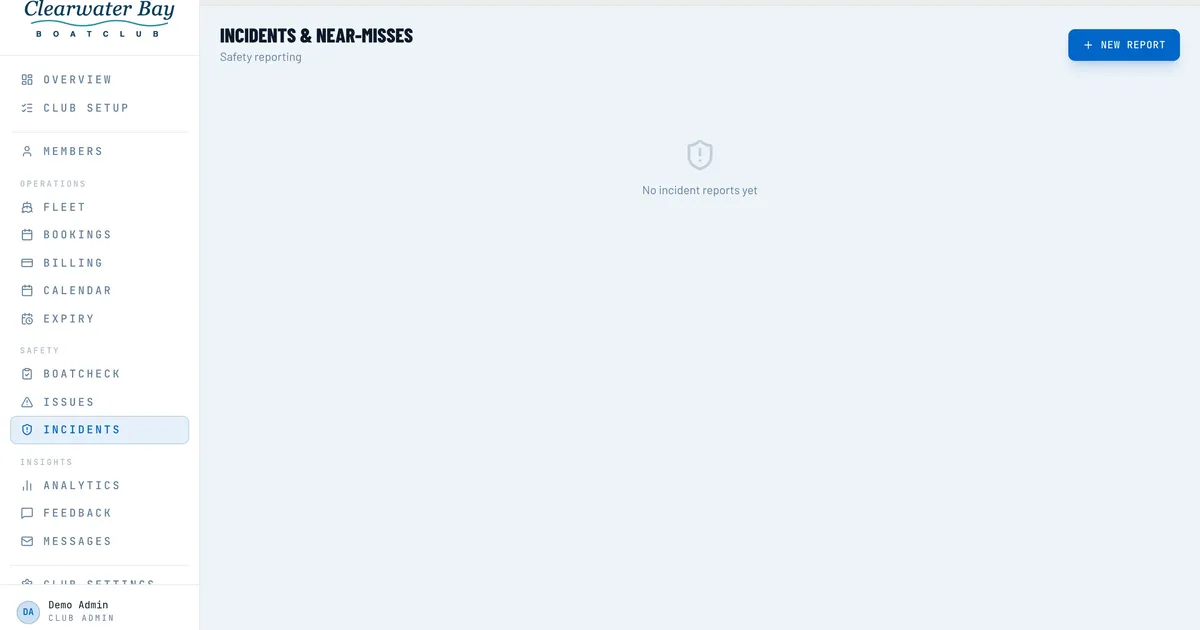
Nobody joins a boat club committee hoping to spend an evening with a loss adjuster. But incidents happen: a RIB meets a pontoon harder than intended, a member slips on a wet deck, an engine dies at the worst possible moment. When they do, the insurer's questions arrive quickly, and they are rarely about the incident itself. They are about everything that came before it.
The difference between an insurance claim that settles smoothly and one that drags on for months is usually paperwork written before anyone needed it. Not a folder of policies and procedures, but records of what the club actually did — dated, attributable, and kept as a habit rather than assembled in a scramble afterwards.
Start with the uncomfortable question. A member took a boat out this morning. Could you show what was checked before they left the pontoon? Kill cord, fuel, bilge, lines, VHF. Could you show the same for the ten outings before that?
Most clubs check their boats. Far fewer can prove it. A verbal culture of "give her a once-over before you go" is genuinely valuable on the water and worth almost nothing in a claims file. What carries weight is a dated record with a name against it, in a consistent format, completed whether or not anything interesting was found. A dog-eared checklist filled in every single time beats an immaculate one filled in occasionally. And ten entries in the same biro, plainly written in one sitting, is worse than no record at all, because it tells the reader that your club reconstructs rather than records.
The next question concerns the person at the wheel. Your rules probably say something like "Powerboat Level 2 or club assessment required for the sports RIB". Good. Can you show that the member aboard that day actually held it? More to the point, can you show the club checked before handing over the boat, rather than after the phone call from the harbourmaster?
A spreadsheet of certificates last touched two AGMs ago answers neither question. The strongest position a club can hold is structural: the qualification is checked at the point of booking, so an unqualified member could never have had the boat in the first place. Whether you manage that with software or with a booking secretary of terrifying diligence, the principle is the same — entitlement verified before the trip, with a trace left behind.
When something does go wrong, the most valuable document is the one written the same day. Memory fades fast, and it fades in a particular direction: accounts grow tidier, timings grow vaguer, and details that seemed unimportant disappear altogether. A report written three weeks later, once a claim looks likely, reads exactly like what it is.
Structure matters almost as much as speed. A form that asks specific questions captures things a shaken writer would never think to volunteer: time, conditions, who was aboard, what happened, damage, injuries, witnesses. The same facts scrawled on the back of a fuel receipt carry less weight, because a consistent format is itself evidence of how the club is run.
Near-misses deserve identical treatment. The tow line that nearly found a propeller, the mooring cleat that shifted underfoot: recording these costs five minutes and shows a club that notices trouble early and acts on it. Often the near-miss report is the document that prevents the claim, because the cleat gets fixed before anyone goes in the water.
The fourth strand is maintenance history. After any incident involving the boat itself, someone will ask whether the problem was foreseeable. If a member reported a sticking throttle three weeks earlier and nothing was written down about what happened next, that silence sits at the centre of your claim and will not budge.
The record you want reads like a story. Reported on the 4th; boat taken out of service that afternoon; engineer's note on the 6th; part fitted on the 9th; back in service on the 10th. Each step dated, each step with a name on it. In most clubs that story is scattered across a WhatsApp thread, two phone calls and the memory of whoever spoke to the engineer. Gathering it into one place, boat by boat, is half the job of defending a claim done in advance.
None of this survives on good intentions alone. Committees change, enthusiasm dips, and any system that relies on someone remembering to fill in a form after a long, cold day on the water will produce gaps exactly where you least want them.
The durable fix is to make records a by-product of running the club rather than a separate chore. A booking system that enforces qualification requirements produces its own proof that the helm was entitled to be there. A pre-use inspection completed digitally on a tablet carries its own date, photographs and inspector's name. A structured incident form filled in on a phone that evening and emailed straight to management beats anything reconstructed in the new year. That is the honest case for software such as Nauticore — not that it makes a club paperless, but that the records get written while everyone thinks they are simply running the club.
With luck you will never need any of it. That is rather the point. The clubs that have the smoothest claims are the ones whose records were kept for their own sake, season after season, long before anyone asked to see them.
See it in action
All Nauticore features are live in the interactive demo — no signup required.